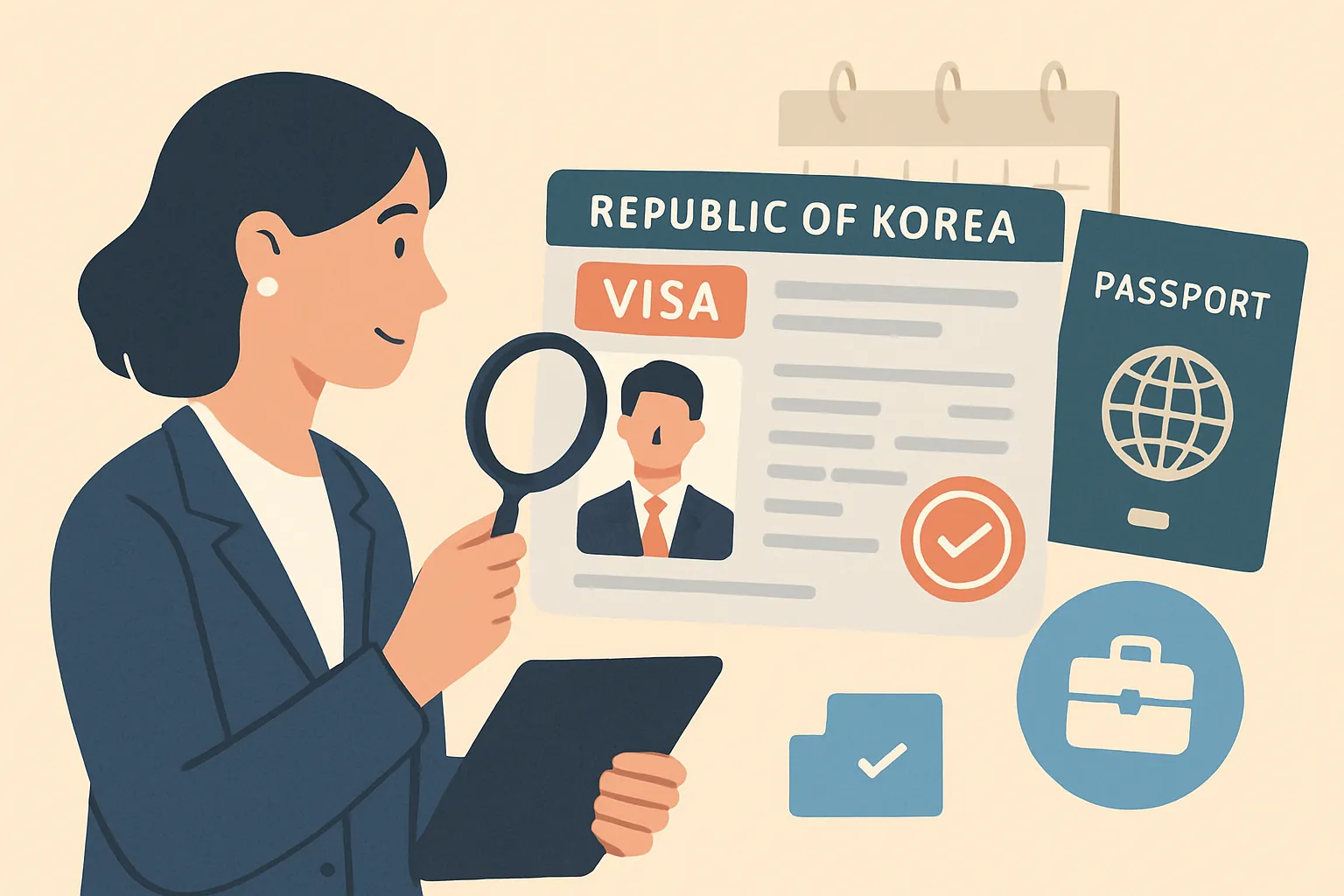
If you’re planning to work in Korea, the visa letter on your passport decides almost everything: what jobs you can take, whether you can change employers, and how long you can stay. Pick the wrong category and you can end up stuck in a job you can’t legally leave, or barred from work you’re qualified for. This is a walk through the main work visa types, who each one is really for, and the questions to ask before you commit.
I’ll keep the Korean terms in parentheses where they matter, because that’s what you’ll see on your visa sticker and your foreigner registration card (외국인등록증).
Key takeaways
- Your visa type is tied to the kind of work and, for many categories, to a specific employer.
- E-9 and H-2 cover most manual and service labor; F-4 and F-5 give the widest freedom but need heritage or residency.
- E-7 is the route for skilled and professional roles, but the job title has to match an approved occupation.
- Changing employers is easy on some visas and tightly limited on others, so check this before you accept a job.
- Always confirm the current rules with your local immigration office (출입국·외국인청) or HiKorea, because conditions change.
How the categories are grouped
Korea’s work visas fall into a few loose families. There’s the low- and semi-skilled labor group, mainly E-9 and H-2. There’s the professional and skilled group, which includes E-1 through E-7. And there are the residence-based statuses like F-4, F-5, and F-6 that let you work with far fewer strings attached.
The single biggest divide isn’t skill level. It’s whether your right to work is attached to one employer or to you as a person. On employer-tied visas, quitting without a proper transfer can put your legal status at risk. On residence-based visas, you carry the work right with you.
The main work visa types
E-9 (Non-professional Employment / 비전문취업)
This is the visa most people mean when they talk about “foreign workers” in Korea. It runs through the Employment Permit System (고용허가제, EPS) and covers manufacturing, agriculture, fishing, construction, and some service sectors. Workers come from countries that have signed an EPS agreement with Korea.
The trade-off is control. You’re tied to your workplace, and switching employers is only allowed under specific conditions (business closure, non-payment of wages, certain contract situations), usually with a cap on how many times you can move. If your employer treats you badly, know that legitimate transfer routes exist. Don’t just walk off the job, because that can push you out of status.
H-2 (Working Visit / 방문취업)
H-2 is for ethnic Koreans (재외동포) from specific countries, most commonly China and CIS states. It’s more flexible than E-9. Holders can work across a broader list of industries and change jobs more freely, as long as they register their employment. Think of it as a middle ground between E-9’s tight control and F-4’s open access.
F-4 (Overseas Korean / 재외동포)
If you’re of Korean descent and qualify, F-4 is one of the best statuses you can hold. You can work in most fields without needing an employer to sponsor you, and you can change jobs freely. There are restrictions on simple labor and a few sensitive occupations, but for professional and skilled work it’s remarkably open. Eligibility depends on your ancestry and documentation proving the Korean lineage.
E-7 (Special Occupation / 특정활동)
E-7 is the professional and skilled worker route: designers, engineers, IT specialists, cooks in specialty restaurants, and many other roles on the approved occupation list. The catch is that your specific job has to match one of those designated occupations, and the employer has to justify hiring a foreigner over a local. Your salary and qualifications are checked against thresholds that vary by role.
E-1 to E-6 (Professors, teachers, specialists, artists)
These narrower categories cover specific professions. E-1 is for professors, E-2 for foreign-language instructors, E-3 for researchers, E-5 for licensed professionals like doctors or lawyers, and E-6 for arts and entertainment. Each has its own credential requirements. If you’re a native English teacher, E-2 is almost certainly your category.
F-5 and F-6 (Permanent residence and marriage)
F-5 is permanent residence, which comes with the freest work rights of all. F-6 is for spouses of Korean nationals, and it also lets you work without employer sponsorship. Neither is a “work visa” in the strict sense, but both give you the right to work, which is what actually matters day to day.
Quick comparison
| Visa | Best for | Job flexibility | Main requirement |
|---|---|---|---|
| E-9 | Manual labor via EPS | Low, employer-tied | EPS country, passed EPS-TOPIK |
| H-2 | Ethnic Koreans, broad work | Medium, register jobs | Korean descent, eligible country |
| F-4 | Overseas Koreans, skilled work | High, no sponsor needed | Proven Korean ancestry |
| E-7 | Skilled/professional roles | Medium, tied to occupation | Job on approved list, credentials |
| E-2 | Language instructors | Low to medium, employer-tied | Degree, clean criminal record |
| F-5 / F-6 | Long-term residents, spouses | Very high | Residency or marriage to a citizen |
How to figure out which one is yours
Start with what you can’t change: your background. Are you of Korean descent? That usually points to F-4 or H-2, which are far more flexible than the alternatives. Are you married to a Korean citizen? F-6 solves the problem entirely.
If neither applies, the question becomes about the work itself. For skilled or professional roles with a degree or relevant experience, check whether your exact job appears on the E-7 approved occupation list. For teaching a language, it’s E-2. For manual labor through a government program, it’s E-9, which means going through the EPS process in your home country before you even arrive.
One thing people get wrong: they assume a job offer automatically means they’ll get the matching visa. It doesn’t. The employer has to be eligible to sponsor, the role has to fit the category, and quotas can be full. Get the employer to confirm the sponsorship in writing before you turn down other options.
Common mistakes that cause visa trouble
- Working outside your visa’s scope. An E-2 teacher doing weekend office work is technically violating status, even if the pay is small.
- Changing employers without approval on a tied visa. This is the fastest way to fall out of status on E-9.
- Assuming the visa transfers with a new job. On most work visas, a new employer means a new sponsorship or a status change application.
- Letting the visa or foreigner registration card expire. Renewal has to be filed before the expiry date, not after.
If you’re unsure whether a side activity is allowed, ask immigration first. A single phone call is cheaper than a violation record.
Where to verify the current rules
Visa conditions, occupation lists, and salary thresholds change, sometimes more than once a year. Don’t rely on a forum post from three years ago. The two sources worth checking are the HiKorea portal (hikorea.go.kr) and your nearest immigration office (출입국·외국인청). Many offices have interpreters or multilingual guides, and EPS workers can also get help through the Employment Permit System channels in their home country.
FAQ
Can I switch from E-9 to a better visa later?
Sometimes, but it’s not automatic. Moving to E-7 usually requires meeting the skilled-worker criteria, including relevant qualifications and an eligible job. Some E-9 workers with long service and Korean language ability can pursue a skilled-worker status, but the requirements are strict. Talk to immigration about your specific case.
Does a work visa let my family come with me?
It depends on the category. Professional visas like E-7 generally allow dependents on an F-3 visa. E-9 typically does not allow family accompaniment. Check your specific visa’s rules before making plans.
What’s the difference between my visa and my foreigner registration card?
The visa is your permission to enter and stay for a purpose. The registration card (외국인등록증) is your ID inside Korea, issued after you register locally within the required period after arrival. You need both, and both have expiry dates you must track.
Can I work while my status change application is pending?
Not automatically. Working before approval can count as an unauthorized activity. Confirm with immigration whether interim work is permitted in your situation, and get it in writing if possible.
Which visa gives the most freedom to change jobs?
F-5 (permanent residence) is the freest, followed by F-4 and F-6. Among true work visas, H-2 is more flexible than E-9 or E-7. If job mobility matters to you, factor that in before accepting a position.
The safest move is always the same: confirm your exact situation with immigration before you sign anything or quit anything. Rules shift, individual cases vary, and the cost of a wrong guess is your legal status.
Related articles
- Viza oʻzgartirish agentligi (비자 변경 대행): kimga kerak va qanday tanlash kerak
- Chi phí gia hạn visa cho người nước ngoài tại Hàn Quốc 2026
- ค่าต่อวีซ่าเกาหลี 2026: ค่าธรรมเนียมจริง ค่าปรับ และวิธีคิดล่วงหน้า
- 외국인등록증 발급 준비서류, 빠짐없이 챙기는 실전 가이드 2026
👉 Get matched to the right job in 30 seconds at 114114AI
Just enter your name, region, job type, experience, and desired salary — AI recommends matching jobs from across Korea.
답글 남기기